
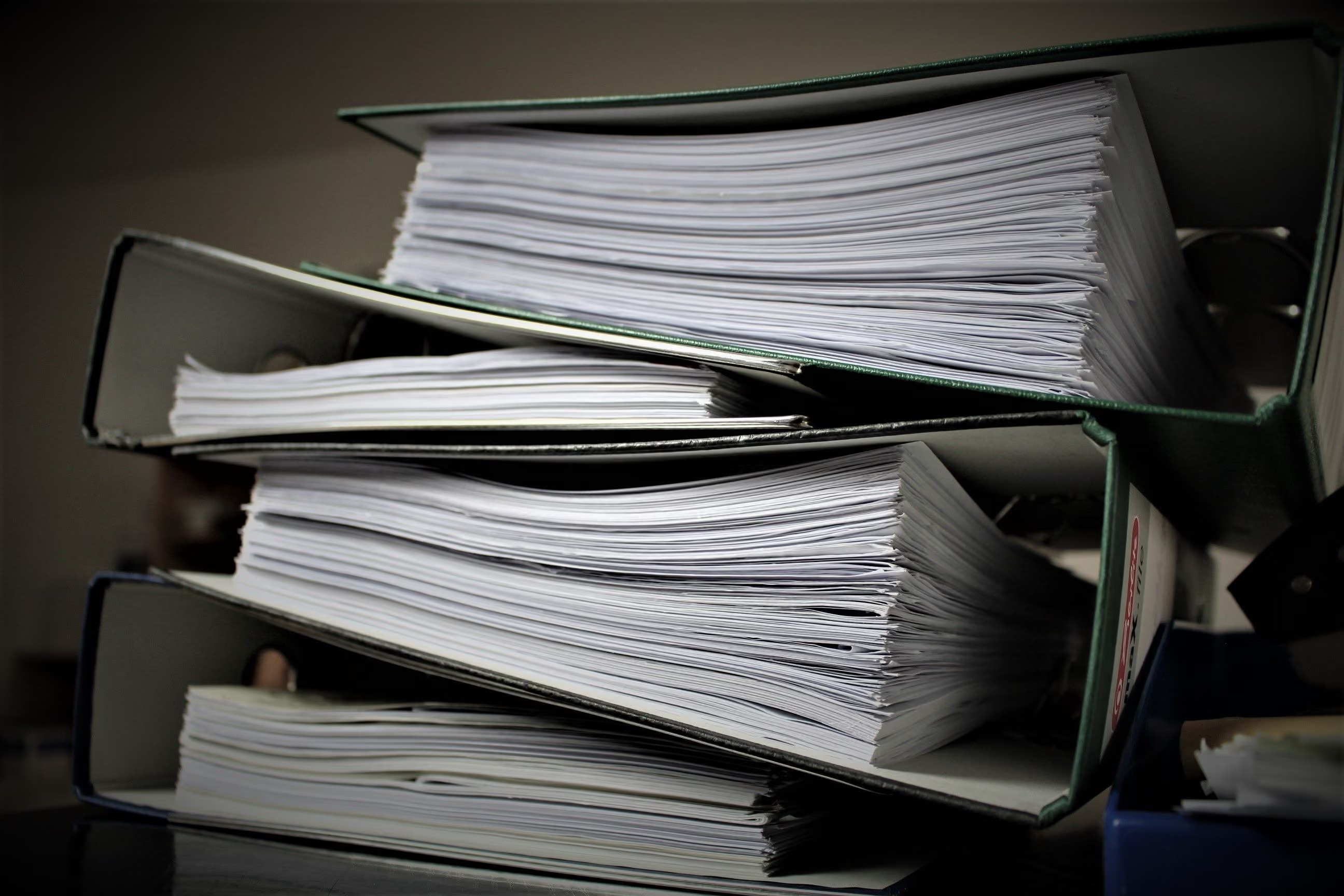
AI can already summarise a contract, pull data out of an invoice, classify a document and find information a person would take much longer to track down.
But there is one problem.
Before AI does anything with a document, you still need to know:
- Where is the document?
- Which is the latest version?
- Which case file or process does it belong to?
- Who needs to approve it?
- Who is allowed to access it?
If you answer these questions with a mix of email, folders, Excel and “ask a colleague”, AI won’t solve the underlying problem. You’ll just be putting very advanced technology on top of a disorganised process.
AI has sped up document work. It hasn’t removed the need to manage documents.
In 2025, AIIM (Association for Intelligent Information Management) surveyed 600 companies in the US, Germany, Austria and Switzerland. As many as 78% of them said they already use AI operationally in document processing.
So AI is no longer an experiment.
But the more document content we can process automatically, the more important it is to stay in control of each document’s lifecycle. That is the job of a document management system (DMS).
A digital folder and a DMS are not the same thing
A common misconception is that a company already has document management because it uses a shared space: OneDrive, Google Drive or some other cloud storage.
Cloud storage answers an important question: where do we keep the file?
A DMS answers a wider one: what happens to the document in the business process?
In a folder, you can find a contract. In a well set-up DMS process, you know who received it, who reviewed it, who needs to sign off, who is allowed to access it, what stage it’s at and what comes next.
The most expensive document isn’t the lost one
The most expensive document is the one everyone thinks they know the location of.
One version is in an email. Another is in a folder. A third is saved locally on someone’s computer. Someone sent a change, and someone else didn’t see the message.
And then the familiar loop begins:
“Is this the latest version?”
“Who approved it?”
“Are we still waiting for someone?”
“Who has it now?”
“Did you send it?”
None of these checks takes long, but when they are repeated hundreds of times a month, admin becomes part of a process nobody consciously designed.
A good DMS manages the flow, not just the file
That is why TQORE DMS is built to do more than an electronic archive. Documents are connected to access control, approval workflows, activity tracking, deadlines, responsibilities and dedicated business modules (registry office, human resources, fleet management).
This is the path a single document takes:
- Intake and registration: the document is registered electronically and gets a number and a barcode.
- Automatic linking: when it is scanned, the system recognises the barcode and immediately attaches the document to the right case file.
- Assignment: it is clear which unit and which case handler are responsible.
- Processing and approval: the document goes through defined steps, and everyone who needs to act gets a notification.
- Deadline tracking: legal and internal deadlines are tracked automatically.
- Archiving: a closed case file goes into the digital archive with its complete history.
- Reporting: management sees the number of received, resolved and open case files in real time.
The goal isn’t just for the document to be digital. The goal is for it to be part of a controlled process.
From practice: 3 implementations
Barcodes instead of manual linking. A company processed a large number of incoming documents every day and linked them to case files by hand. After the barcode module was introduced, the system recognises each document and attaches it to its case file on its own. Scanning and registration are much faster, there are fewer errors, and the same team processes more documents.
The end of paper registers. A second company ran all of its office administration on paper. An electronic registry office, case file management, a digital archive and electronic workflows were introduced, along with staff training. The paper registers were retired, and management now sees the status of every case file in real time.
Requests that track themselves. A third company had no overview of how many requests had been received, resolved and left open. Processing of its specific forms was automated, and statuses and reports are now generated automatically. Decisions are made on up-to-date data.
So where does AI come in?
This is exactly where it gets interesting.
Modern AI technologies already make it possible to classify documents, extract data, summarise content and run advanced content searches. They are most valuable when they work on documents and processes that are already organised, meaning when the system already knows what a document is, where it belongs and who has the right to use it.
In TQORE DMS implementations today, we use automatic barcode recognition to link each document to the right case file.
That is why companies thinking about AI shouldn’t skip the less exciting question:
How well organised are our documents and processes today?
AI can dramatically speed up a good process. But it can also dramatically speed up chaos.
Real digitalisation doesn’t start with a scanner
It doesn’t start with an AI chatbot either. It doesn’t even start with moving from paper to PDF.
It starts the moment a company can clearly answer: how does information enter the system, what steps does it go through, who is responsible, and how do we know the process is finished?
Only then does technology stop being an extra tool and start changing the way the organisation works.
TQORE DMS is used by public institutions and companies in Bosnia and Herzegovina. TQORE is ISO certified for the design, development and implementation of document management information systems.
Not just where your documents are. What happens to them.
→ Book a consultation for TQORE DMS
Frequently asked questions
What is a DMS?
A DMS (Document Management System) is software used to register, store, search, approve and archive documents. Every activity is logged and access is controlled.
What is the difference between a DMS and Google Drive or a shared folder?
A folder answers the question of where a file is saved. A DMS also answers which process the document belongs to, who handled it, who needs to approve it, who is allowed to access it and what stage it’s at.
How does a DMS work?
When a document arrives, it is registered and linked to a case file or process. It then goes through defined processing and approval steps and is finally archived. Along the way, the system tracks deadlines and logs every activity.
Who needs a DMS?
Organisations with a lot of documentation, several departments and approval processes that are hard to track through email, folders and paper. That means public institutions, public enterprises and companies with substantial administration.
What is electronic office administration?
It means running all office administration electronically, from receiving and registering a document to archiving it, with no paper logbooks or registers.
Sources
- AIIM, AIIM Study Reveals AI-Driven Transformation in Document Processing (2025; 600 companies, US, Germany, Austria, Switzerland): https://info.aiim.org/aiim-study-reveals-ai-driven-transformation-in-document-processing
- Practice examples: anonymised TQORE DMS implementations (TQORE internal data).